This is a transcription of the article published by the Fascist dictator Benito Mussolini on June 1924 issue of English Life. The political secretary of the Italian Socialist Party Giacomo Matteotti will reply in the issue of July 1924.
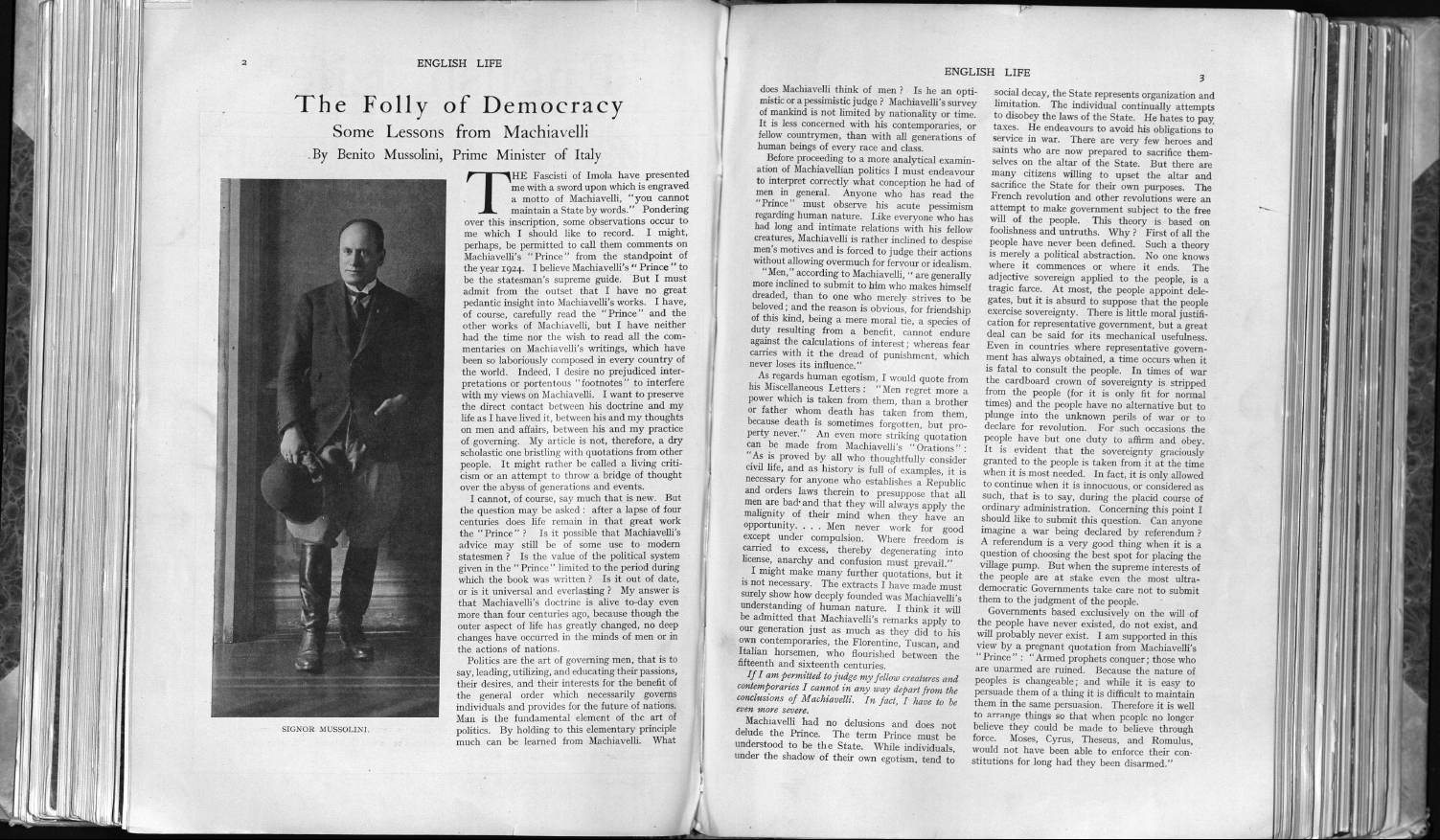
Some lessons from Machiavelli
by Benito Mussolini Prime Minister of Italy
The Fascisti of Imola have presented me with a sword upon which is engraved a motto of Machiavelli “You cannot maintain a state by words” Pondering over this inscription some observations occur to me which I should like to record. I might perhaps be permitted to call them comments on Machiavelli’s Prince from the standpoint of the year 1924.
I believe Machiavelli’s Prince to be the statesman supreme guide by I must admit from the outset that I have no great pedantic insight into Machiavelli’s works. I have of course carefully read the Prince and the other works of Machiavelli but I have neither had the time nor the wish to read all the commentaries on Machiavelli’s writings, which have been so laboriously composed in every country of the world.
Indeed I desire no prejudiced interpretation or portentous “footnotes” interfere with my views on Machiavelli. I want to preserve the direct contact between his doctrine and my life as I have lived it, between his and my thoughts on man and affairs, between his and my practice of governing. My article is not therefore a dry scholastic one bristling with quotations from other people. It might rather be called a living criticism or an attempt to throw a bridge of thought over the abyss of generations and events.
I cannot of course say much that is new. But the question may be asked: after a lapse of four centuries does life remain in that great work the “Prince”? Is it possible that Machiavelli’s advice may still be of some use to Modern statesmen? Is the value of the political system given in the “Prince” limited to the period during which the book was written? Is it out of date or is it universal and everlasting? My answer is that Machiavelli’s doctrine is alive today even more than four centuries ago, because though the outer aspect of life has greatly changed, no deep changes have occurred in the minds of men or in the actions of nations. Politics are the art of governing men, that is to say leading, utilizing, and educating their passions, their desires and their interest for the benefit of the general order which necessarily governs individuals and provides for the future of nations.
Man is the fundamental element of the art of politics. By holding to this elementary principle much can be learned from Machiavelli. What does Machiavelli think of men? Is he an optimistic or a pessimistic judge? Machiavelli’s survey or mankind is not limited by nationality or time. It is less concerned with this contemporaries or fellow countrymen than with all generations of human beings of every race and class.
Before proceeding to a more analytical examination of Machiavellian politics I must endeavour to interpret correctly what conception he had of men in general. Anyone who has read the prince must observe execute pessimism regarding human nature. Like everyone who has had a long and intimate relations with his fellow creatures, Machiavelli is rather inclined to despise men’s motives and his forced to judge their actions without allowing overmuch for fervour or idealism.
“Men” according to Machiavelli, “are generally more inclined to submit to him who makes himself dreaded than to one who merely strives to be beloved. And the reason is obvious for friendship of this kind being a mere moral tie, a species of duty resulting from a benefit, cannot endure against the calculations of interest; whereas fear carries with it the dread of punishment which never loses its influence”.
As regards human egotism I would quote from his Miscellaneous Letters: “ men regret more a power which is taken from them than a brother or father whom death has taken from them because death is sometimes forgotten but property never “. An even more striking quotation can be made from Machiavelli’s “Orations”: “As is proved by all who thoughtfully consider civil life, and as history is full of examples, it is necessary for anyone who establishes a republic and orders laws therein to presuppose that all men are bad and that they will always apply the malignity of their mind when they have an opportunity… Men never work for good except under compulsion. Where freedom is carried to excess, thereby degenerating into license, anarchy and confusion must prevail”.
I might make many further quotations, but it is not necessary. The extracts I have made must surely show how deeply founded was Machiavelli’s understanding of human nature. I think it will be admitted that Machiavelli’s remarks apply to our generation just as much as they did to his own contemporaries, the Florentine, Tuscan, and Italian horsemen who flourished between the 15th and 16th centuries.
If I am permitted to judge my fellow creatures and contemporaries I cannot in any way depart from the conclusions of Machiavelli. In fact I have to be even more severe.
Machiavelli had no delusions and does not delude the Prince. The term Prince must be understood to be the State. While individuals under the shadow of their own egotism, tend to social decay, the state represents organization and limitation. The individual continually attempts to disobey the laws of the State. He hates to pay taxes. He endeavours to avoid is obligations to service in war. There are very few heroes and saints who are now prepared to sacrifice themselves on the altar of the State. But there are many citizens willing to upset the altar and sacrifice the state for their own purposes. The French Revolution and other revolutions were an attempt to make government subject to the free will of the people. This theory is based on foolishness and untruths. Why? First of all the people have never been defined. Such a theory is merely a political abstraction. No one knows where he commences or where it ends. The objective sovereign applied to the people is a tragic farce. At most the people appoint delegates but it is absurd to suppose that the people exercise sovereignty. There is little moral justification for representative government but a great deal can be said for its mechanical usefulness. Even in countries where representative government has always obtained, a time occurs when it is fatal to consult the people. In times of war the cardboard crown of sovereignty is stripped from the people (for it is only fit for normal times) and the people have no alternative but to plunge into the unknown perils or war or to declare for revolution.
For such occasions the people have but one duty to affirm and obey. It is evident that the sovereignty graciously granted to the people is taken from it at the time when it is most needed. In fact it is only allowed to continue when it is innocuous, or considered as such, that is to say during the placid course of ordinary administration. Concerning this point I should like to submit to this question. Can anyone imagine a war being declared by referendum? A referendum is a very good thing when it is a question of choosing the best spot for placing the village pump. But when the supreme interest of the people are at stake even the most ultra-democratic government take care not to submit them to the judgment of the people. Governments based exclusively on the will of the people have never existed, do not exist and will probably never exist. I am supported in this view by a pregnant quotation from Machiavelli “Prince”: “Armed prophets conquer, those who are unarmed are ruined”. Because the nature of peoples is changeable and while it is easy to persuade them of a thing, it is difficult to maintain them in the same persuasion. Therefore it is well to arrange things so that when people no longer believe they could be made to believe through force. Moses, Cyrus, Theseus and Romulus would not have been able to enforce their constitutions for long had they been disarmed”.
 Andrea Pisauro
Pingback: Machiavelli, Mussolini, and Fascism | Andrea Pisauro·